
A BioClear® smile transformation.
Tara came to Dr. Rod Strober looking for a brighter, more balanced smile and a conservative way to address two specific concerns.
Her treatment focused on a darkened front tooth following previous root canal treatment and a visible space between teeth numbers 9 and 10.
Two small details were affecting the balance of her entire smile.
Tara wanted a whiter, brighter smile that still felt like her own. Her most noticeable concern was a front tooth that had darkened after previous root canal treatment.
She also had a space between teeth numbers 9 and 10. Together, the discoloration and spacing interrupted the visual continuity of her upper front teeth.
After evaluating the teeth, surrounding gums, existing dental work, bite, and Tara’s goals, Dr. Rod Strober recommended BioClear as an option for addressing the color and contour concerns.
Cosmetic treatment begins with identifying what is actually creating the concern.
Similar-looking smile concerns can have very different causes and may require different treatment approaches.
A darkened tooth
Internal discoloration following previous dental treatment may not respond to whitening in the same way as natural enamel.
A visible space
The space between teeth 9 and 10 affected the visual rhythm and continuity of the upper front teeth.
An uneven transition
Color, width, contour, and contact points needed to be considered together rather than treating each detail in isolation.
A conservative solution
Tara wanted a meaningful cosmetic improvement while preserving as much healthy natural tooth structure as practical.
A matrix-assisted composite approach designed around the existing tooth.
BioClear uses specially shaped matrices and tooth-colored composite material to build new contours around selected teeth.
Rather than simply placing a small patch of bonding material on one surface, the technique can wrap composite around more of the tooth to create smoother transitions, contact areas, and proportions.
For Tara, BioClear allowed Dr. Strober to address the visible discoloration and space while creating a more continuous appearance across the treated teeth.
Explore BioClear TreatmentMask selected discoloration
Composite shade and opacity can be selected to improve how a darkened tooth relates visually to neighboring teeth.
Refine tooth shape
New contours can be developed to improve apparent width, proportion, symmetry, and transitions between teeth.
Close selected spaces
Composite can be shaped to close appropriate spaces and improve the contact area between neighboring teeth.
Limit unnecessary reduction
In selected cases, BioClear may require less removal of natural tooth structure than a traditional full-coverage restoration.
A brighter and more continuous appearance across the front teeth.
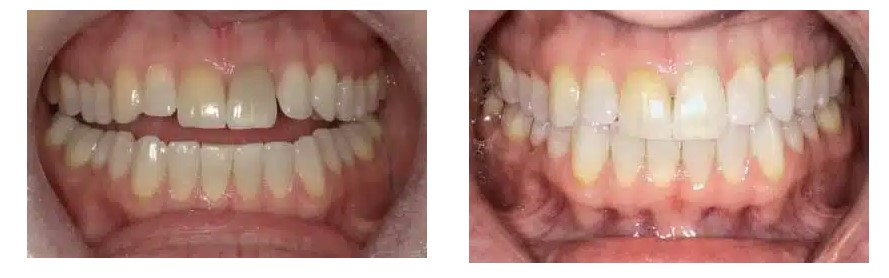
Before-and-after photography represents this individual patient. Treatment recommendations and results vary.
Improved visual harmony
The darkened tooth was restored to coordinate more closely with the surrounding smile.
A more continuous contact
The visible space was closed through carefully developed composite contours.
More balanced tooth shapes
The treated teeth were shaped to create a smoother relationship with neighboring teeth.
The final appearance is planned before composite is placed.
BioClear treatment varies according to the condition, position, color, and number of teeth being treated.
Schedule a ConsultationUnderstand the tooth and surrounding smile
Dr. Strober evaluates tooth health, previous treatment, color, spacing, gum position, bite, and the patient’s cosmetic goals.
Select the intended shape and shade
The restoration is planned to coordinate with neighboring teeth rather than treating the tooth as an isolated feature.
Clean and condition the treatment area
The tooth is prepared according to its existing condition and the amount of composite needed for the planned result.
Shape composite within the BioClear matrix
Tooth-colored composite is placed and shaped using a selected matrix to develop the new contour and contact area.
Adjust, finish, and polish
The restoration is evaluated for contour, surface texture, contact, bite, comfort, and visual integration.
BioClear may be used for more than one type of cosmetic concern.
The condition of the tooth and the extent of the desired change determine whether BioClear, veneers, crowns, orthodontics, or another treatment is more appropriate.

The goal is not to create a generic smile.
Dr. Rod Strober has practiced dentistry since 1993 and combines cosmetic planning with restorative and functional considerations.
Each cosmetic recommendation begins with the individual tooth, surrounding smile, gumline, bite, existing dentistry, and the patient’s priorities.
That approach allows BioClear to be considered alongside whitening, veneers, clear aligners, crowns, and other treatments rather than presenting one procedure as the answer for every patient.
Is BioClear the right treatment for your smile?
An examination is necessary to determine whether the tooth is healthy enough for BioClear and whether another cosmetic or restorative option would provide a more appropriate result.
01 What is BioClear?
BioClear is a matrix-assisted composite technique used to build new tooth contours with bonded, tooth-colored material. It may be considered for selected spacing, black triangles, worn edges, chips, proportions, discoloration, and restorative concerns.
02 Is BioClear the same as a porcelain veneer?
No. BioClear uses bonded composite placed directly on the tooth. A porcelain or ceramic veneer is fabricated separately and bonded over the visible surface of the tooth.
03 Can BioClear close a gap between teeth?
BioClear may close selected spaces by adding carefully shaped composite to one or more teeth. The size of the space, tooth proportions, root position, bite, and gum health must be evaluated first.
04 Can BioClear improve a dark tooth?
Selected discoloration may be masked with composite when the tooth is otherwise appropriate for treatment. The cause and severity of the discoloration affect the recommended approach.
05 Does BioClear require removal of natural tooth structure?
The amount of preparation depends on the condition of the tooth, existing restorations, decay, damage, and the intended result. Some cases require minimal preparation, while others require more extensive treatment.
06 How long does BioClear last?
Longevity varies according to the tooth, bite forces, oral habits, hygiene, diet, treatment size, and maintenance. BioClear restorations may eventually require repair, polishing, or replacement.
07 Can BioClear stain?
Composite materials can change in appearance over time. Coffee, tea, tobacco, diet, hygiene, and surface wear may affect color and polish.
08 How do I care for BioClear restorations?
Brush, clean between the teeth, attend routine dental visits, and follow any instructions provided by Dr. Strober. Patients who clench or grind may also be advised to use a protective appliance.
09 Will my result look exactly like Tara’s?
No individual result can be duplicated or guaranteed. Tooth color, shape, position, gumline, bite, existing dental work, and treatment goals differ from patient to patient.
10 How do I schedule a BioClear consultation?
Request an appointment online or call Country Club Dentistry at (760) 832-7915.
Suite A & B
Rancho Mirage, CA 92270
9:00 AM–5:00 PM
Start with what bothers you. Build from what makes you unique.
Meet with Dr. Rod Strober to compare BioClear, veneers, clear aligners, whitening, and other cosmetic options based on your teeth and goals.